Bitcoin Chart: A Complete Expert Guide to Understanding, Reading, and Using Bitcoin Charts Like a Pro
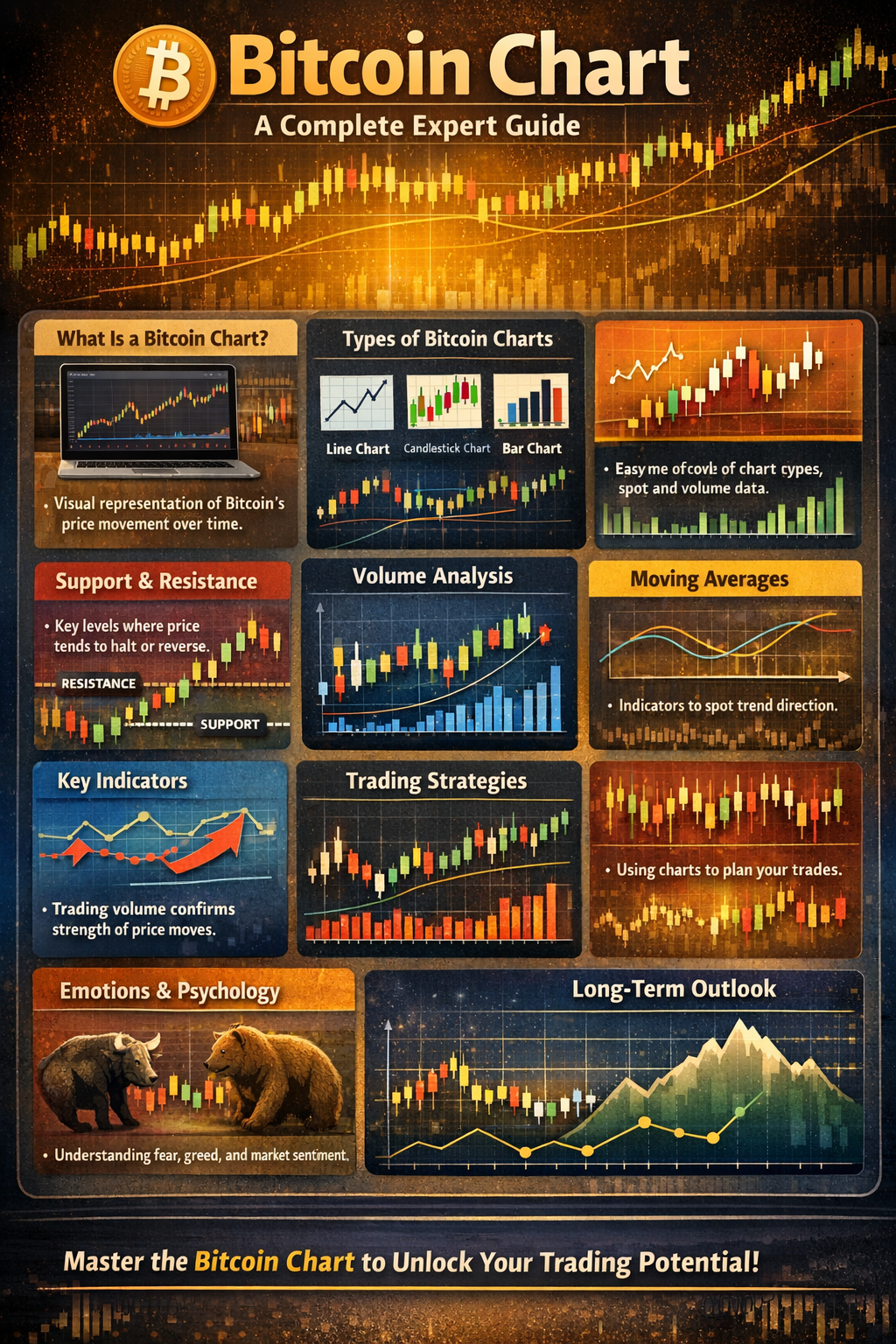
to the Bitcoin Chart
The bitcoin chart is one of the most powerful tools in the cryptocurrency world. Whether you are a complete beginner or someone who has been trading crypto for years, the bitcoin chart is where all real decision-making starts. Prices, trends, emotions, market psychology, and investor behavior are all reflected visually through the chart. In simple terms, the bitcoin chart tells the story of Bitcoin’s past, present, and possible future.
Unlike traditional assets such as stocks or commodities, Bitcoin trades 24/7, which makes its chart far more dynamic and emotionally driven. There are no closing bells, no weekends off, and no centralized control. This nonstop trading environment means that bitcoin charts can change rapidly, forming patterns that reflect global sentiment in real time. From sudden spikes caused by news to long periods of consolidation, everything shows up on the chart.
For anyone serious about understanding Bitcoin, learning how to read and analyze a bitcoin chart is not optional—it’s essential. This guide breaks down everything you need to know, from basic chart types to advanced technical analysis concepts, all explained in a practical and easy-to-understand way.
What Is a Bitcoin Chart?
A bitcoin chart is a visual representation of Bitcoin’s price movement over a specific period of time. It displays how the price has changed, whether it’s rising, falling, or moving sideways. The chart usually includes price on the vertical axis and time on the horizontal axis, making it easy to track historical trends and price behavior.
Bitcoin charts can be viewed in different timeframes, such as minutes, hours, days, weeks, or even years. Shorter timeframes are often used by traders who make frequent trades, while longer timeframes are favored by investors who focus on long-term trends. This flexibility makes the bitcoin chart useful for all types of market participants.
Beyond just price, most bitcoin charts also include additional data such as trading volume, indicators, and overlays. These extra elements help traders and investors interpret market strength, momentum, and potential future movements, turning the chart into a complete decision-making tool.
Why the Bitcoin Chart Matters So Much
The bitcoin chart matters because it reflects real market behavior rather than opinions or predictions. While news headlines and social media can influence sentiment, the chart shows what people are actually doing with their money. Every buy, sell, panic, and rally is captured in the chart’s structure.
One major reason the bitcoin chart is so important is volatility. Bitcoin is known for sharp price swings, and these movements often follow recognizable patterns. Traders use charts to identify these patterns early, allowing them to manage risk and identify opportunities before major moves happen.
For long-term investors, the bitcoin chart provides perspective. Zooming out reveals Bitcoin’s historical growth, cycles, and corrections. This broader view helps investors avoid emotional decisions and understand where the current price fits within Bitcoin’s long-term trend.
Types of Bitcoin Charts Explained
Line Chart
The line chart is the simplest type of bitcoin chart. It connects closing prices over a selected time period, creating a smooth line that represents overall price direction. Because it removes most short-term noise, it’s ideal for beginners or long-term investors who want a clean view of price movement.
While line charts are easy to read, they lack detail. They don’t show price ranges within a timeframe, meaning you can’t see volatility or intraday swings. This limitation makes them less useful for active traders.
Still, line charts are excellent for identifying major trends, support and resistance levels, and overall market direction without distractions.
Candlestick Chart
The candlestick chart is the most popular and widely used bitcoin chart type. Each candlestick represents a specific time period and shows four key pieces of information: open, close, high, and low prices.
Candlesticks provide far more insight than line charts. The shape, size, and color of each candle reveal market sentiment. Long candles show strong momentum, while short candles suggest indecision or consolidation.
Experienced traders rely heavily on candlestick patterns to anticipate potential reversals or continuations. Patterns such as doji, engulfing candles, and pin bars all communicate valuable information about buyer and seller strength.
Bar Chart
Bar charts are similar to candlestick charts but use vertical bars instead of candles. Each bar still shows open, close, high, and low prices, just in a different visual format.
While bar charts are less visually intuitive for many people, some traders prefer them for their clean appearance. They remove some of the visual noise that candlesticks can create.
Bar charts are commonly used in combination with other technical tools rather than as a standalone analysis method.
Understanding Timeframes on a Bitcoin Chart
Timeframes determine how much price data is shown in each candle or bar on the bitcoin chart. A 1-minute chart shows rapid price changes, while a daily or weekly chart shows long-term trends.
Short timeframes are popular with day traders and scalpers. These charts offer more trade opportunities but also come with higher noise and emotional pressure. Price movements can change quickly, requiring constant attention.
Longer timeframes are favored by swing traders and investors. They reduce noise and provide clearer trend signals. Many professionals recommend starting analysis on higher timeframes before zooming into lower ones for entries.
Bitcoin Chart Trends and Market Structure
Trends are the foundation of bitcoin chart analysis. A trend represents the general direction in which the price is moving. There are three main types of trends: uptrend, downtrend, and sideways movement.
An uptrend is defined by higher highs and higher lows. This structure shows that buyers are in control and are willing to pay increasingly higher prices. Uptrends often last longer than expected, especially in strong bull markets.
A downtrend features lower highs and lower lows, indicating selling pressure. Sideways trends, also known as consolidation phases, occur when price moves within a range. Understanding these structures helps traders align with market direction instead of fighting it.
Support and Resistance in Bitcoin Charts
Support and resistance are among the most important concepts in bitcoin chart analysis. Support is a price level where buying interest tends to stop further declines. Resistance is where selling pressure prevents price from rising further.
These levels are not exact numbers but zones where market participants react. When Bitcoin approaches support, buyers often step in. When it approaches resistance, sellers tend to appear.
Once broken, support can turn into resistance and vice versa. This role reversal is a powerful signal that traders use to confirm trend continuation or potential reversals.
Volume Analysis on the Bitcoin Chart
Volume shows how much Bitcoin is being traded during a specific time period. It plays a crucial role in confirming price movements. Strong price moves with high volume are more reliable than moves with low volume.
Rising volume during an uptrend suggests strong buying interest and conviction. Falling volume during a rally may indicate weakness and potential reversal. Similarly, high volume during sell-offs often signals panic or capitulation.
Volume analysis helps traders distinguish between real breakouts and false moves. Without volume confirmation, price action alone can be misleading.
Moving Averages on the Bitcoin Chart
Moving averages smooth out price data and help identify trends. Common types include the Simple Moving Average (SMA) and Exponential Moving Average (EMA).
Short-term moving averages respond quickly to price changes, while long-term averages move more slowly. Crossovers between different moving averages often signal trend changes.
For example, when a short-term moving average crosses above a long-term one, it may indicate bullish momentum. These tools are widely used because they are simple yet effective.
Bitcoin Chart Indicators Explained
Technical indicators are mathematical calculations applied to price and volume data. Popular indicators include RSI, MACD, Bollinger Bands, and stochastic oscillators.
Indicators help traders measure momentum, overbought or oversold conditions, and trend strength. However, they should not be used in isolation. Indicators work best when combined with price action and market structure.
Overloading a bitcoin chart with too many indicators can lead to confusion. Experienced traders focus on a few well-understood tools rather than chasing every signal.
Bitcoin Chart Patterns You Should Know
Chart patterns are recurring formations that reflect market psychology. Common patterns include triangles, flags, wedges, head and shoulders, and double tops or bottoms.
These patterns form as buyers and sellers battle for control. Breakouts from these structures often lead to strong moves, especially when confirmed by volume.
While patterns don’t guarantee outcomes, they provide probability-based scenarios that help traders plan entries, exits, and risk management.
Long-Term Bitcoin Charts and Market Cycles
Looking at long-term bitcoin charts reveals clear market cycles. Historically, Bitcoin moves through accumulation, expansion, distribution, and correction phases.
These cycles are often influenced by halving events, macroeconomic conditions, and adoption trends. Long-term charts help investors identify where Bitcoin currently sits in its cycle.
Understanding cycles reduces emotional decision-making and helps investors stay patient during periods of consolidation or correction.
Bitcoin Chart Psychology and Market Emotions
Every bitcoin chart reflects human emotions such as fear, greed, hope, and panic. Sharp sell-offs often represent fear, while parabolic rallies reflect greed and FOMO.
Understanding this emotional aspect helps traders avoid common mistakes. Buying into hype near market tops and selling in panic near bottoms are classic errors visible on charts.
Experienced traders learn to read emotional extremes on the bitcoin chart and position themselves accordingly.
Common Mistakes When Reading Bitcoin Charts
One common mistake is overtrading based on short-term fluctuations. Constantly reacting to small price movements often leads to losses.
Another mistake is ignoring higher timeframes. Focusing only on short-term charts without understanding the broader trend can result in poor decisions.
Lastly, many traders rely too heavily on indicators without understanding price action. The chart itself should always be the primary source of information.
Using Bitcoin Charts for Trading Strategies
Bitcoin charts are the backbone of trading strategies. From scalping to swing trading, all approaches rely on chart analysis.
A solid strategy includes entry criteria, exit rules, stop-loss placement, and position sizing. Charts help traders visualize and execute these plans objectively.
Consistency in applying chart-based strategies is more important than finding the “perfect” setup.
Bitcoin Chart Analysis for Long-Term Investors
Investors use bitcoin charts differently than traders. Instead of focusing on short-term entries, they analyze macro trends, support zones, and historical growth patterns.
Long-term charts help investors identify accumulation zones and avoid emotional reactions to temporary price drops.
This approach aligns with Bitcoin’s historical tendency to reward patience over speculation.
The Future of Bitcoin Chart Analysis
As Bitcoin adoption grows, chart analysis continues to evolve. Institutional participation, algorithmic trading, and global macro factors are increasingly influencing price behavior.
Advanced tools such as on-chain data overlays and sentiment indicators are becoming more common on bitcoin charts.
Despite these advancements, the fundamentals of chart analysis remain the same: understanding price, volume, and human behavior.
Final Thoughts on the Bitcoin Chart
The bitcoin chart is more than just lines and candles—it’s a living reflection of the global market’s perception of Bitcoin. Learning how to read it properly opens the door to better decision-making, risk management, and confidence.
Whether you are trading daily or investing for the long term, mastering the bitcoin chart gives you a significant edge. It helps cut through noise, control emotions, and align with market reality.
In the ever-changing world of cryptocurrency, the bitcoin chart remains one of the most reliable tools available. Those who learn to respect and understand it are far better positioned to succeed in the Bitcoin market.














Post Comment