Golden Ratio in Architecture Examples: The Beauty of Perfect Proportion
Have you ever wondered why certain buildings instantly look pleasing to the eye? The answer often lies in the golden ratio — a mathematical concept that has guided architects and artists for centuries. Known for its harmony and balance, the golden ratio is one of the most fascinating tools in design and architecture.
In this article, we’ll explore golden ratio in architecture examples, how it works, and why it continues to influence modern and historical structures alike. Whether you’re an architect, student, or design enthusiast, you’ll find inspiration in how simple proportions can create timeless beauty.
What Is the Golden Ratio?
The golden ratio, often represented by the Greek letter Φ (Phi), equals approximately 1.618. It’s a mathematical proportion that appears when a line is divided into two parts so that the longer part divided by the shorter part equals the whole length divided by the longer part.
Mathematically, it’s expressed as:
a/b = (a + b)/a = 1.618
This ratio has been admired since ancient times for creating natural balance and visual harmony. It’s found not only in art and architecture but also in nature — from the spirals of seashells to the arrangement of leaves and even the human body.
Why Architects Use the Golden Ratio
Architects use the golden ratio to achieve aesthetic balance and visual appeal. It helps determine ideal proportions for building elements such as windows, doors, facades, and entire structures.
Key reasons architects apply the golden ratio:
Harmony: It creates a sense of natural balance that feels pleasing to the human eye.
Consistency: It helps align various architectural elements into a cohesive whole.
Timelessness: Buildings based on this ratio often appear elegant, regardless of era or style.
Psychological Impact: The ratio subtly influences how people perceive beauty and proportion.
The Golden Ratio in Architecture: Historical Examples
Let’s look at some of the most iconic golden ratio in architecture examples throughout history. These structures demonstrate how this simple mathematical principle has shaped architectural masterpieces for centuries.
The Great Pyramid of Giza
Perhaps one of the oldest known examples of the golden ratio in architecture, the Great Pyramid of Giza reflects near-perfect golden proportions.
The ratio between the height of the pyramid and half its base length is approximately 1.618.
This creates a visually harmonious structure that has fascinated mathematicians and architects for thousands of years.
The Egyptians might not have consciously used the mathematical value of Phi, but their intuitive understanding of proportion led them to design a monument that aligns with the golden ratio.
The Parthenon, Athens
The Parthenon is one of the most famous examples of golden ratio architecture in history.
The dimensions of its façade and the spacing of columns align closely with the golden ratio.
The ratio between the building’s width and height follows Phi, creating visual symmetry and balance.
This temple, built in 447 BC, demonstrates how ancient Greek architects understood the importance of mathematical proportions in achieving architectural perfection.
Notre-Dame Cathedral, Paris
The Notre-Dame Cathedral showcases how medieval architects incorporated divine proportions into religious architecture.
The façade’s height and width follow the golden ratio.
The placement of windows, towers, and central portals are proportionally balanced.
The golden ratio here contributes to the cathedral’s breathtaking harmony, symbolizing both spiritual and mathematical beauty
The Taj Mahal, India
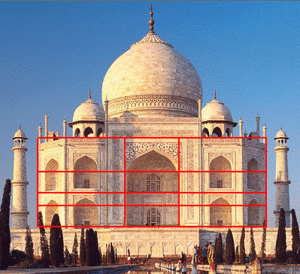
One of the world’s most beautiful buildings, the Taj Mahal, also exhibits the golden ratio in its design.
The height of the main dome compared to the entire facade follows a ratio close to 1.618.
The gardens and surrounding structures are laid out in proportional harmony.
This balance creates a sense of peace and symmetry, which is why the Taj Mahal is often cited as a perfect example of golden ratio design in architecture.
The Pantheon, Rome
The Pantheon is another outstanding example of mathematical precision.
The ratio of the dome’s diameter to the height of the building approximates the golden ratio.
This symmetry gives the structure its enduring aesthetic power.
Even after 2,000 years, the Pantheon’s design feels modern, balanced, and timeless — all thanks to its perfect proportions.
The Golden Ratio in Modern Architecture
The golden ratio isn’t just an ancient concept. It continues to influence modern architecture today. Many architects use it to design buildings that feel both futuristic and naturally pleasing.
Let’s explore a few modern golden ratio in architecture examples that showcase this timeless principle in action.
The United Nations Secretariat Building, New York
The UN Secretariat Building, designed by Le Corbusier and Oscar Niemeyer, incorporates the golden ratio in its dimensions.
The ratio between the width and height of the building aligns closely with Phi.
This proportion gives the tower an elegant, balanced appearance.
Le Corbusier was a known advocate of the golden ratio and believed it created architectural harmony that aligned with human perception.
The Guggenheim Museum, New York
Designed by Frank Lloyd Wright, the Guggenheim Museum is a modern masterpiece that uses the golden ratio in its spiraling ramp and overall proportions.
The spiral expands according to the Fibonacci sequence, which is directly linked to the golden ratio.
This design not only provides structural balance but also enhances the visitor’s experience through movement and flow.
Villa Savoye, France
Another creation by Le Corbusier, the Villa Savoye reflects modernist principles grounded in mathematical precision.
The building’s layout, facade, and window placement follow the golden ratio.
Every element, from the open floor plan to the curved ramp, follows harmonious proportions.
This is one of the best-known golden ratio in architecture examples in modern residential design.
The CN Tower, Toronto
Though not as widely discussed, the CN Tower also demonstrates golden ratio principles in its proportions.
The ratio of the tower’s total height to its observation deck aligns with Phi.
This contributes to its sleek and balanced design.
The Golden Ratio and the Fibonacci Sequence
The Fibonacci sequence (1, 1, 2, 3, 5, 8, 13, 21…) is closely related to the golden ratio. Each number in the sequence is the sum of the two before it. When you divide consecutive Fibonacci numbers (like 21/13 or 34/21), the result approaches 1.618 — the golden ratio.
Many architects use Fibonacci-based proportions to guide the layout of buildings, staircases, and even landscape elements. This connection between nature, mathematics, and design enhances both the beauty and function of architectural structures.
How to Use the Golden Ratio in Architecture
For architects or designers wanting to incorporate the golden ratio, here are some practical methods:
Facades and Layouts: Use Phi to determine the ideal ratio between height and width.
Windows and Doors: Apply the golden rectangle (where sides are in 1:1.618 ratio) for openings and frames.
Interior Spaces: Design rooms or furniture layouts using golden proportions for harmony.
Landscapes and Pathways: Apply Fibonacci spirals or golden rectangles in garden layouts.
Graphics and Signage: Maintain proportional balance even in small design details.
Benefits of Using the Golden Ratio in Architecture
Aesthetic Harmony: Designs feel naturally pleasing.
Structural Balance: Proportions align in a visually consistent way.
Timeless Design: Golden ratio structures stand the test of time.
Psychological Comfort: People instinctively respond positively to balanced proportions.
Criticism and Misconceptions
While the golden ratio is widely admired, some critics argue that its presence in architecture is sometimes coincidental rather than intentional. Not all ancient architects consciously applied Phi — some proportions may simply reflect practical or aesthetic choices.
However, whether intentional or not, the outcome often reflects the universal appeal of balanced design, proving that the golden ratio aligns naturally with human perception of beauty.
The Golden Ratio Beyond Architecture
The influence of the golden ratio extends far beyond buildings. You’ll find it in:
Art: Leonardo da Vinci’s Vitruvian Man and The Last Supper
Nature: Flower petals, shells, hurricanes, and galaxies
Product Design: Apple logo, credit cards, and even everyday packaging
Photography: Composition techniques based on the golden spiral
Its versatility across creative fields highlights its timeless relevance.
Conclusion: The Timeless Beauty of Mathematical Harmony
The golden ratio in architecture examples prove one thing: beauty isn’t random — it’s mathematical. From the Great Pyramid of Giza to modern skyscrapers, this simple ratio continues to shape how we define balance and elegance.
Architects across generations have used Phi to design spaces that resonate with human emotion, natural harmony, and structural perfection. Whether consciously applied or intuitively discovered, the golden ratio reminds us that mathematics and art are deeply connected.
So next time you admire a building, take a closer look — you might just find the golden ratio hiding in plain sight.











Post Comment